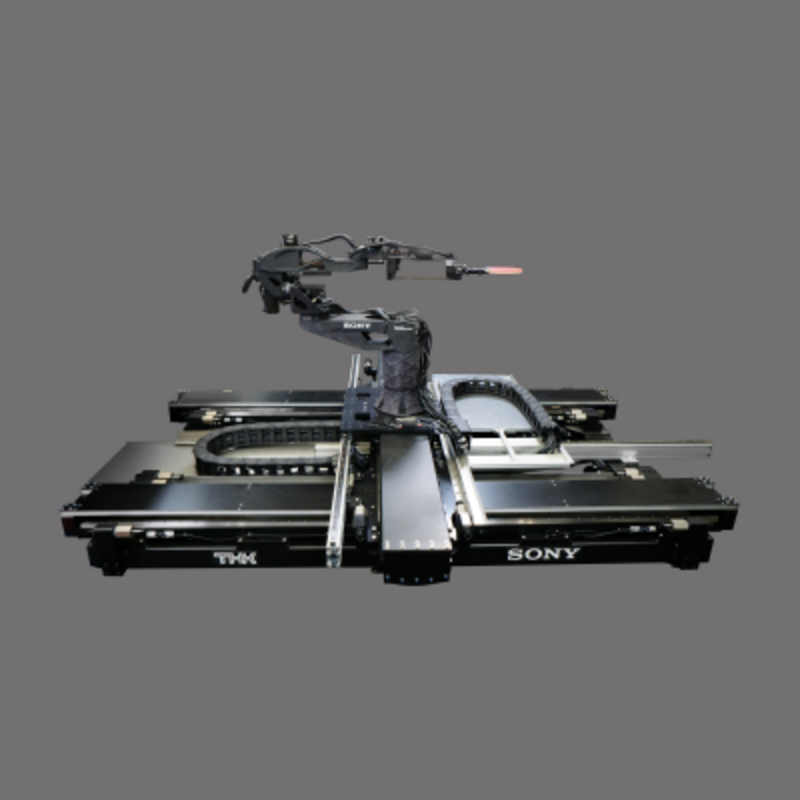
Ace system: autonomous table-tennis robot system
Joined ATTA on April 2026
Project_Ace
source: THK株式会社
Description
An autonomous system capable of competing against professional-level table tennis players in real-world settings. It features a main unit that combines an XY linear motor-driven stage (THK-manufactured)—capable of achieving 0.8-second recip
Details
Features and specs
Availability
Local Name
Manufacturer
SONY AI
Release date
April 2026
Country of Origin
Japan
Core Function
Others
Robot series
Dimensions
-
Weight
-
Power
Power source: Not specified|Power consumption: GCS PC 381 W|Ball detection FPGA 64 W|Perception and control PC 83 W|Robot actuators 10’700 W (rated)|Total power consumption 11’228 W
Connectivity
[Wired] EtherCAT communication
Operation environment
Olympic-size court: 7m7m5m on the player side|Light intensity: around 1,400 lux | Working envelope: Observed 2.3*2.4m
Other specifiacations
8 degrees of freedom (two prismatic and six revolute joints)|9APS cameras |3GCSs|Each GCS: EVS camera with Sony IMX636 sensor, pan and tilt mirrors, telephoto tunable lens|3D ball location: 200 Hz, 3.0 mm error, 10.2 ms latency on average|Angular velocity estimates: approximately 400–700 Hz|Average angular velocity measurement error: 24.8 rad s−1|RL policy: 31.25 Hz|32-ms segment trajectory|Trajectory sampled at 1 kHz|End effector: Butterfly Dignics 05 2.1 mm rubbers attached to a VICTAS ZX-GEAR OUT blade and small cup|Material: Scalmalloy|Total latency: 20.2 ms|Maximum racket linear velocity: 19.8 m/s|Maximum ball linear velocity: Serve 9.1 m/s, Return 16.4 m/s|Maximum ball angular velocity: Serve 376 rad/s, Return 600 rad/s

Current availability
Under Study
Available Countries
Japan
Industry
Information and communication | Professional, scientific and technical activities | Arts, entertainment and recreation
Price
Not for sale